On the night of July 17
th, the NCPA comic opera commission
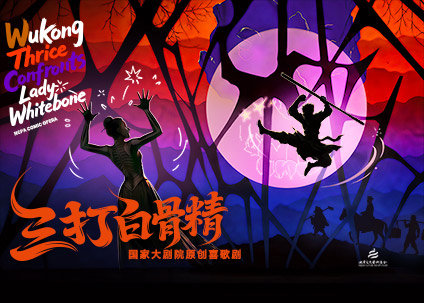
Wukong Thrice Confronts Lady Whitebone had its premiere. Crafted over three years, this opera reconstructs the classic from a contemporary perspective through its witty musical language, cyberpunk-style production and modern philosophical reflections. While bringing laughter to audiences, the opera delivers deep philosophical insights; and alongside its lighthearted story, it also offers enduring aftertaste. It conveys the core values of upholding firm faith, distinguishing right from wrong, and pursuing justice to audiences.
The comic opera commission Wukong Thrice Confronts Lady Whitebone is compact in musical structure and tells a story that is full of twists and turns. Composer Hao Weiya scored the work for a 32-member chamber ensemble, with the National Ballet of China Symphony Orchestra performing under the baton of Lai Jiajing. Employing modern performing techniques, the artists created amazing yet playful timbres on a colourful array of instruments. Especially, the acoustic space was greatly enriched by such traditional Chinese instruments as the guzheng, sheng and Chinese bamboo flute. The composer also brought the fight scenes to life with opera percussion and acrobatic fighting arts. The stage dialogue, designed by the librettist WANG Yuanfei, is highly consistent with the musical style. The comedic conceit of a “spicy hot pot banquet held to feast on Tang Monk’s flesh”, as well as the comical “real-life” dialogue, drew frequent laughter from the audience.
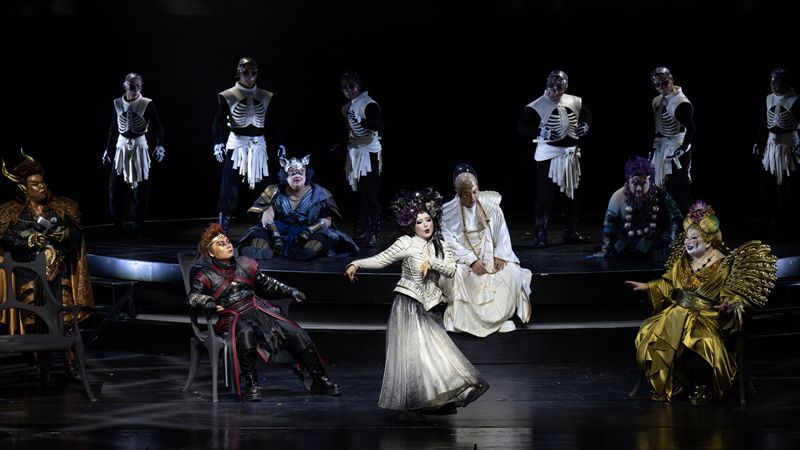
HANG Wenqin took on four distinct roles — four incarnations of Lady Whitebone — in entirely different vocal timbres and physical postures. The true form of Lady Whitebone is a coloratura soprano with a bright voice. With a thin voice and flamboyant gestures, the soprano conjures exactly the kind of “demon” Lady Whitebone is meant to be. For the role of the village girl, she adopted a tender tone infused with Chinese folk singing techniques. For the old woman, she sounded like an alto. For the old man, she performed in a husky voice as if she were a contralto. Different from the original story, the opera features a more complex, layered and multifaceted heroine, a character that the creative team strove to design during dramatic reconstruction. Lady Whitebone’s entrance aria, Ah, A Flood of Moonlight, recounts her backstory — “Seduced by earthly desires, she falls into love’s snare, banished to the desolate wilderness”, becoming a demon in barren mountains. Transformation into a Village Maiden is a demanding aria, in which ZHANG rapidly switched between characters, giving a humorous performance that captures the demon’s gleeful triumph as she ensnares Tang Monk.
Wukong, played by LIANG Yufeng, is really a “monkey” who is, however, good at expressing feelings delicately. Tortured by the tightening band, he writhed in agony. Driven out by his master, he sang Eyes Wet with Tears. torn between inner conflict and unwavering devotion, he evokes both sympathy and admiration in audiences. ZHU Bajie, played by KOU Jing, is honest and adorable. His aria
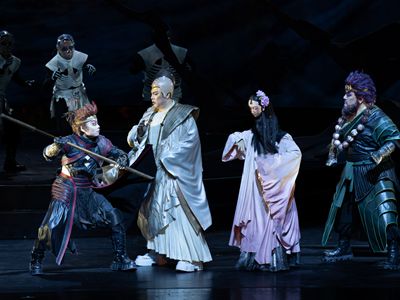
Phooey is charged with comedic vigour. In the Boyue Cave scene, he “comes to rescue, only to fail”, drawing a roar of laughter from the audience. Tang Monk, portrayed by ZHANG Yang, is composed and reserved. At the banquet, he confesses, “Wukong, I misjudged you.” His confession marks his awakening and willingness to acknowledge his mistakes as a “leader”, which is a significant step forward on his journey for Buddhist scriptures. SHA Wujing, played by GUAN Zhijing, unleashes formidable power in silence. In Nine Questions, a duet sung together with Tang Monk, their exchange deepens progressively , shifting from personal concerns to the greater good, spanning the past and the future, as they conduct thorough self-examination. HU Yue, an actress, takes on the role of Tathagata. She has a mellow and deep voice, tinged with an air of detached authority in her performance. She issues an order as she drinks tea - a scene in which the supreme deity is more down-to-earth. Yet in the end, Tathagata fails to get Lady Whitebone among the immortals as he has promised. Instead, he just dispatches other demons to further test Tang Monk. This is a subtle metaphor that “there is no absolute distinction between good and evil”.
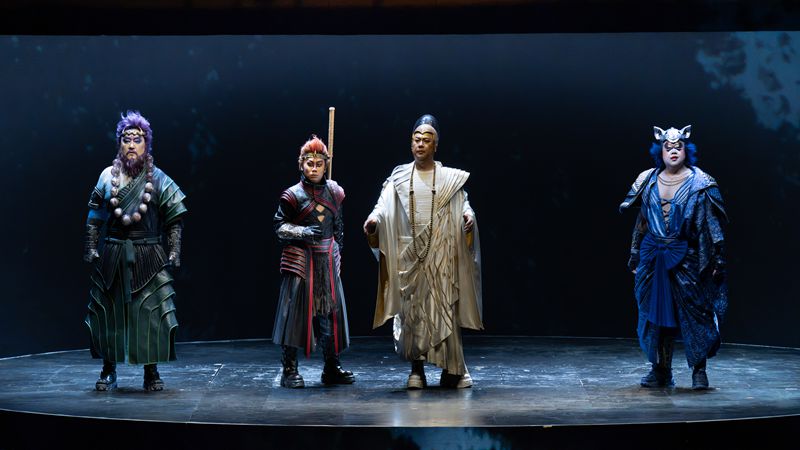
Beyond the principal cast, the array of demons, diverse in form, also adds considerable charm to the opera. WU Song gives a particularly impressive portrayal of Immortal Golden Toad, who stands out with his exaggerated physique and witty lines, eliciting laughter with every gesture. For the scene where Wukong disguises himself as the toad, it is a “two-person one”, the director WANG Xiaoying gives an ingenious idea that the two characters should perform simultaneously, creating delightfully whimsical moments. The banquet is the most bustling scene, with a parade of demons involved, including the Yellow-Robed Demon, Green-Haired Lion Demon, Spider Demon, Centipede Demon, Bull Demon King and Princess Iron Fan. They take the stage one after another as distinct characters, performing their unique arias, with every demon brought vividly to life.
The stage design is notably avant-garde for the comic opera commission
Wukong Thrice Confronts Lady Whitebone. Set designer Liu Kedong crafted a minimalist yet visually striking stage space rendered in a cyberpunk style, shaped around the aesthetic tone of modern Chinese design. It is not a mere replication of traditional settings, but an open, thought-provoking theatrical expression. There were many “eyes” seeming to pervade the performance, making it possible to build a philosophical space where “you watch the performance, and the performance watches you back”. There was a giant red eyeball suspended over the stage, looking like Lady Whitebone’s eye, a symbol of how the human realm is watched over by the demonic world. When Tathagata appeared , his golden Buddha-eye looked down from above. This implied that all the 81 ordeals are preordained by the Buddha, with all beings within his grasp. Furthermore , there are other visual elements on the stage, including the “skeleton facing its true essence” and the “mirror for self-scrutiny”, which stand for a strikingly contemporary visual expression of the old tale.
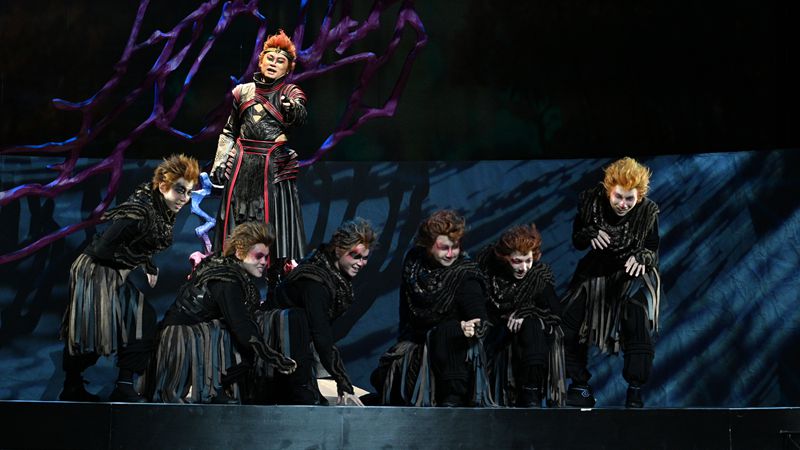
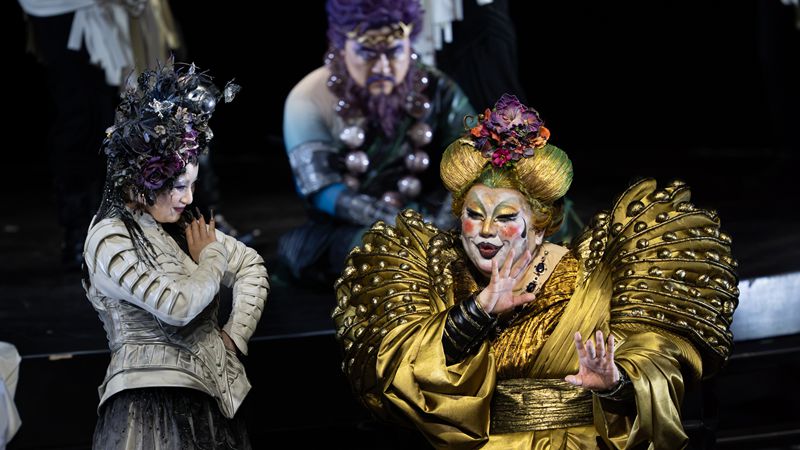
Costume designer PENG Dinghuang reimagined the characters in mecha-inspired costumes, each meticulously crafted. Makeup designer SHEN Miao displayed remarkable ingenuity, crafting characters that retain intrinsic Eastern features while delivering the striking impact of contemporary aesthetics. Lady Whitebone’s ornate headwear is inlaid with elements of traditional opera, looking exquisite. As for Wukong’s facial makeup, the Monkey King’s facial design blended seamlessly with metallic armour, preserving his kingly aura alongside a strong futuristic vibe. Tang Monk’s costume has sci-fi undertones. His transparent cap feels light and ethereal, his snow-white cassock symbolises the fragility of mortal flesh, and touches of gold stand for his nascent spark of Buddha-nature. Departing from the familiar image with oversized ears, Zhu Bajie was fitted with cat-like upright ears, lending natural comedic charm to his demeanour. SHA Wujing, described in the original novel as having a “blue-grey face”, is here given purple hair, a bold contrast to his taciturn demeanour. Tathagata and the two venerable ones appear with golden faces and gender-neutral looks, bathed in golden light — their signature hue that reflects the Buddha’s presence.
The NCPA comic opera commission
Wukong Thrice Confronts Lady Whitebone will continue to have its first season premiere till July 26
th. Following the opening performance, a second cast, including ZHANG Yi, ZHU He, XUE Wencong, ZHOU Xun and ZHAO Ming, will take the stage to give another brilliant performance.



 Repertoire
 Films
Films
 Videos
 Podcast
 China NCPA Orchestra
 China NCPA Chorus
 NCPA Resident Singers
 NCPA Drama Ensemble
 Buildings
Exhibitions
Buildings
Exhibitions
 Opening Hours
Services
Opening Hours
Services
 Western Cuisine
NCPA Café
Arts Gifts
Western Cuisine
NCPA Café
Arts Gifts