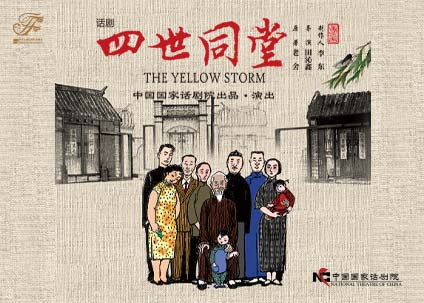
The Yellow Storm is a full-length novel that depicts the lives and resistance of ordinary people in Japanese-occupied Peking during the Chinese People's War of Resistance Against Japanese Aggression. LAO She himself regarded it as “the longest and perhaps the best book” he had ever written, and literary critics rank it among the “Top 100 Chinese Novels of the 20th Century”. Its literary, artistic, philosophical and social value surpasses that of his other works such as Teahouse and Rickshaw Boy. It is even hailed as “a literary classic worthy of being read by every generation of Chinese, and a national memory worth cherishing by every Chinese person”.
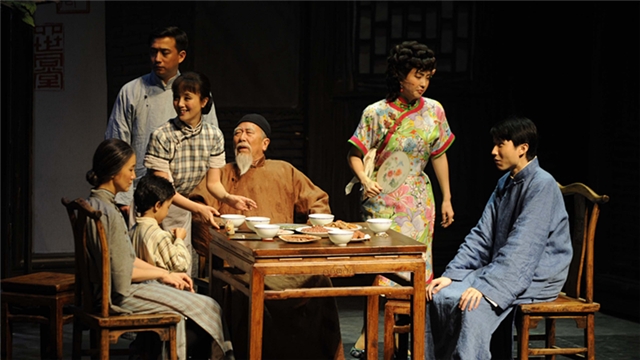
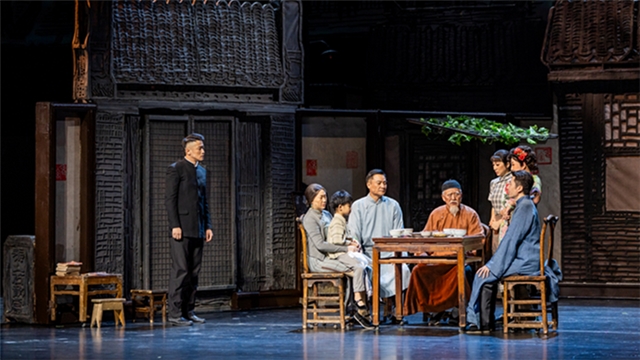
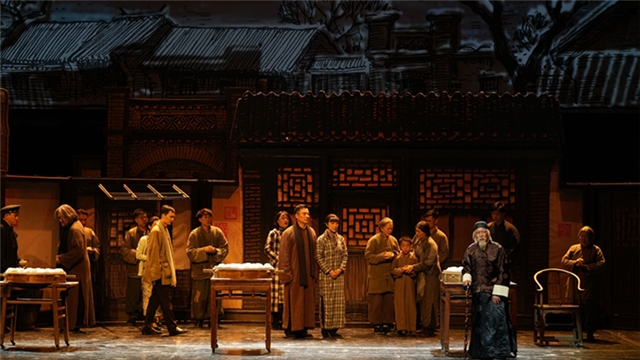
Director TIAN Qinxin turns to a “Neo-realist” approach, by which the Xiaoyangjuan Hutong in Beijing’s Xicheng District — the very alleyway that Lao She wrote about over half a century ago — is almost recreated on the stage. Through ingenious stagecraft, the interiors and courtyards of three households, including QI, GUAN and QIAN, are vividly conjured up on the stage along with the hutong scenery. Interpreted by the performers, the drama unfolds with its sweeping panorama of how Beijing citizens endure hardships and struggle during the eight-year-long Chinese People's War of Resistance Against Japanese Aggression, presenting a stereo picture of Republican Beijing in all its facets, from clothing and food to housing and transportation. Upholding a cultural stance distinctive to Chinese storytelling, with cultural confidence in offering the people the best, the drama brings together outstanding performers from the National Theatre of China as a vivid presentation of LAO She’s monumental “epic of the common people”.
In late October 2010, The Yellow Storm had its sensational premiere at the Sun Yat-sen Memorial Hall, Taiwan, China, playing to a packed house. Deeply moved by the “cultural charm and people of old Beijing”, the audience sighed with emotion that they had “seen living history”. Since then, this story of joy and sorrow, of honour and disgrace — set in Xiaoyangjuan Hutong in wartime Beijing — has toured over 70 cities and regions, including Beijing, Shanghai, Shenzhen, Hong Kong, Macao and Taiwan, China. From 2026 onward, the drama has run for more than 400 performances in Singapore, Australia, and other countries. Wherever it goes, it is embraced by audiences, captivating over 600,000 spectators worldwide with LAO She’s distinctive linguistic charm.
From January 12th to 28th, 2011, the drama The Yellow Storm had its Beijing premiere at the Tianqiao Theatre. To immerse the audience in a strong Beijing atmosphere from the moment they entered the theatre, the organisers set up stalls reminiscent of an old Beijing temple fair in the lobby before the performance. The performance featured a stellar cast of outstanding artists from the National Theatre of China, including LEI Kesheng, SUN Honglei, HUANG Lei (guest), ZHU Yuanyuan, XIN Baiqing, QIN Hailu, YIN Tao, and XING Jiadong — a constellation of stars rarely seen on the stage of Chinese theatre.
On December 29th, 2013, The Yellow Storm was staged at the Great Hall of the People in celebration of the 12th anniversary of the National Theatre of China. The performance drew an audience of 6,000, setting a record for both the largest single-performance attendance and the highest box-office revenue ever achieved by a Chinese theatrical production.
Beloved by audiences far and wide, the drama The Yellow Storm has also garnered numerous prestigious accolades, including the Excellent Production Award at the 2011 National Arts Exhibition and Festival for Art Theatres and Troupes, the China Drama Golden Lion Award in 2012, and the “Wenhua Award for Excellent Production” at the 14th Wenhua Awards.
Creatives
Executive Presenter: TIAN Qinxin
Chief Executive Producer: GONG Baojiang
Executive Producers: BAI Xuefeng, CHENG Peng
Consultants: SHU Ji, SHU Yi
Literary Consultant: ZHENG Wanlong
Academic Consultant: HAN Yuhai
Dramaturg: YANG Qian
Original Author: LAO She
Playwrights: TIAN Qinxin, AN Ying
Director: TIAN Qinxin
Managing Producer: LI Dong
Deputy Stage Director: SUN Xiaoming
Set Designers: XUE Dianjie, WANG Hanyi
Lighting Designer: WANG Ruiguo
Costume Designer: ZHAO Yan
Hair Style Designers: HE Yalin, LIU Lian
Audio Designer: ZHOU Tao
Composer: ZHANG Wei
Props Designer: WANG Pu
Stage Manager: CHEN Long
Technical Manager: ZHAO Liang
Production Coordinators/Performance Coordinators: Laoxiang, WANG Mian
Publicity Coordinator: LIU Mengni
Cast Coordinators: ZHANG Yan, LIU Hanzhong
Set Production Coordinator: GUO Tianqu
Cast
Narrator: LIU Jinshan
QI Family
Old Master QI: HOU Yansong / LIU Mumei
QI Tianyou: JIN Dazhong
QI Tianyou’s Wife: XUAN Yi
QI Ruixuan: XU Wei / ZHANG Lu
YUN Mei: ZHAO Rui / JIANG Muyuanjian
QI Ruifeng: LIU Zhe
Pangjuzi: TAO Hong / YANG Chen
QI Ruiquan: GAO Ang
Xiaoniuzi: CHEN Yunuo
GUAN Family
GUAN Xiaohe: JI Chenmu / FAN Shanghong
Dachibao: ZHAO Hongwei / JIANG Jiaqi
YOU Tongfang: LYU Jing
GUAN Gaodi: WANG Yiqi
QIAN Family
QIAN Moyin: MA Ang
QIAN Moyin’s Wife: ZENG Qi
QIAN Moyin’s Son: ZHANG Jiaqi
QIAN Moyin’s Daughter-in-Law: DENG Shimin
Xiaoyangjuan Hutong
LI Siye: CHEN Qiang
LI Sinai: MA Shanshan
Xiaocui: ZHANG Shuo
Xiaocui’s Wife: XUAN Yi
Grandmother MA: SHI Jialu
CHENG Changshun: GU Zi
Inspector BAI: HAN Minghao
Xiaowen: ZHANG Jiaqi
Xiaowen’s Wife: DENG Shimin
LI Kongshan: DENG Yang
LAN Dongyang: SHAN Guanchao
Rickshaw Boys: WANG Dawei / YAO Hetong / JIANG Hao / YAN Yueming
Japanese Woman: DENG Shimin
Old Japanese Woman: ZENG Qi
A cannon is fired on Lugou Bridge in 1937, kicking off the all-out Chinese People's War of Resistance Against Japanese Aggression, and disrupting the peaceful life in Xiaoyangjuan Hutong, Peking. In troubled times, industrious and honest citizens have their lives getting worse and worse. Rickshaw boy CUI, amateur opera performers Xiaowen and his wife, warm-hearted LI Siye, CHENG Changshun, who has his grandmother as his only relative… They are different from one another in experiences, but they all are deprived of their most basic dignity and hope.
Poet QIAN Moyin, who is indifferent to fame and wealth and lives in harmony with the rest of the world, becomes homeless with all his family members killed in the war. However, the intellectual throws away his cowardice and laziness and becomes a courageous fighter.
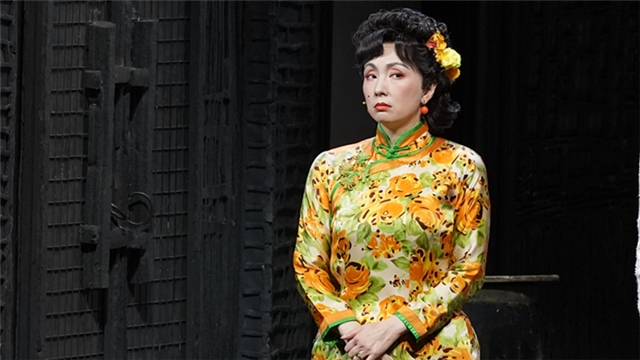
In contrast, some opportunists choose to scramble for power and profit in those turbulent days. GUAN Xiaohe and her husband Dachibao are an example. They lead a prosperous life, which is, however, not recognized by the rest members of the GUAN family.
The QI Family is the most honest and even-tempered family in Xiaoyangjuan Hutong. Faced with turmoil, members of the QI Family take different stands. Old Master QI’s third grandson Ruiquan has gone out to battle and there is no news of him; second grandson Ruifeng finds a cushy job in the government at the instigation of his wife; the eldest grandson Ruixuan is a middle school English teacher, who is anguished at not being able to “fulfill his filial duty” and “pledge loyalty to the country”. When struggling mentally, he and his wife Yun Mei work to support the whole family. Can Old Master QI hold on to his dream of having four generations live under one roof and celebrate his 80th birthday? That’s what he is most concerned about in his last days.
*Please purchase tickets through authorized channels to avoid counterfeiting. Before completing your purchase, please verify the performance date, time, venue, and seat number carefully. Performance tickets are time-sensitive and limited in availability. Once a transaction has been completed, tickets are non-exchangeable, non-refundable and cannot be reissued if lost. Please double-check all ticketing details and securely retain your physical ticket or electronic order. If you are unable to attend due to personal reasons, please make your own arrangements regarding the use of your tickets. We appreciate your understanding as any inconvenience caused.
*The cast, programme, or other performance details are subject to change and shall be based on the live performance. In the event of major adjustments - such as changes to the performance date or lead cast - please refer to the official announcements issued by the NCPA and follow the relevant procedures as instructed.
*The NCPA opens 90 minutes before performances, and 60 minutes before art education lectures and similar events. Auditorium entry begins 45 minutes before performances. For all performances and events, the Northern entrance serves as the sole public entrance. Please ensure that ticket scanning and security screening are completed prior to entry, and allow sufficient time to avoid delays.
*Tickets must be retained in their original, intact condition. Admission will be denied for tickets lacking a stub, or bearing any alterations, obscured information, or defacement. Each ticket is valid for a single entry on the date of the performance. For certain performances, presentation of original valid identification documents is required. Admission will be granted only when the ticket information corresponds with the presented identification.
*Recommended admission height: 1.2 meters and above. Special provisions may apply to certain performances or events, as indicated on the corresponding ticketing page.
*All attendees are required to undergo security screening upon entry. Smoking and open flames are strictly prohibited within the NCPA premises. Prohibited items include, but not limited to, firearms and replicas, controlled knives, flammable or explosive substances, toxic or hazardous materials, corrosive substances, and radioactive materials. Any prohibited items discovered will be handed over to public security authorities.
*For safety and hygiene reasons, the NCPA does not provide storage services for food, beverages, or similar items. The following items are not permitted inside the NCPA: food and drinks, flags & banners, electronic cigarettes, power banks exceeding 20000mAh, flowers, recording or photography equipment, and oversized luggage.
*Attendees are requested to address appropriately. Admissions will be denied to individuals who are improperly attired or under the influence of alcohol.
*If you are late, please wait quietly in the audience waiting area. Entry will be permitted under the guidance of ushers during appropriate intermissions or between movements, and you are requested to take the nearest available seat with minimal disturbance. For concerts consisting of a single piece - either for the entire performance or a complete half - late arrivals and audience who leave midway will not be admitted.
*All attendees are requested to observe proper performance etiquette. Please keep quiet and remain seated throughout the entire performance. Mobile phones should be turned off or set to silent mode, and calls should not be made in the auditorium. Photography, audio, or video recording of the performance is strictly prohibited without prior permission. The use of flashlights, including phone flashlights, is not allowed.
*After the performance, please exit the auditoriums in an orderly manner. Loitering is discouraged.



 Repertoire
 Films
Films
 Videos
 Podcast
 China NCPA Orchestra
 China NCPA Chorus
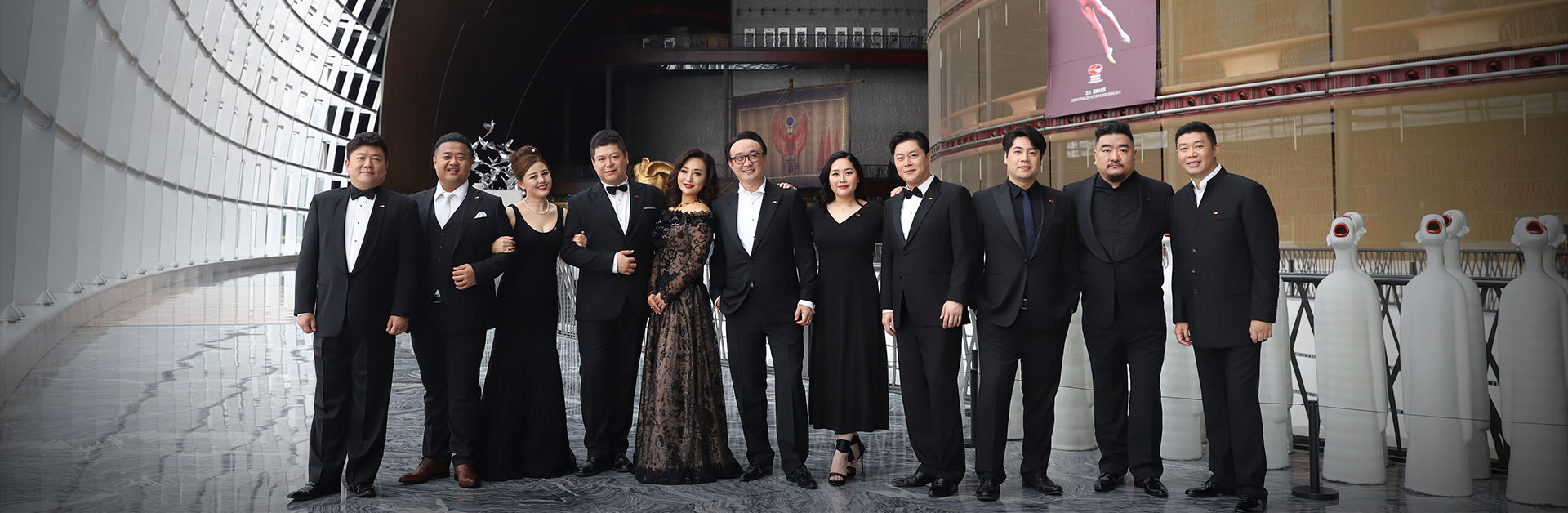 NCPA Resident Singers
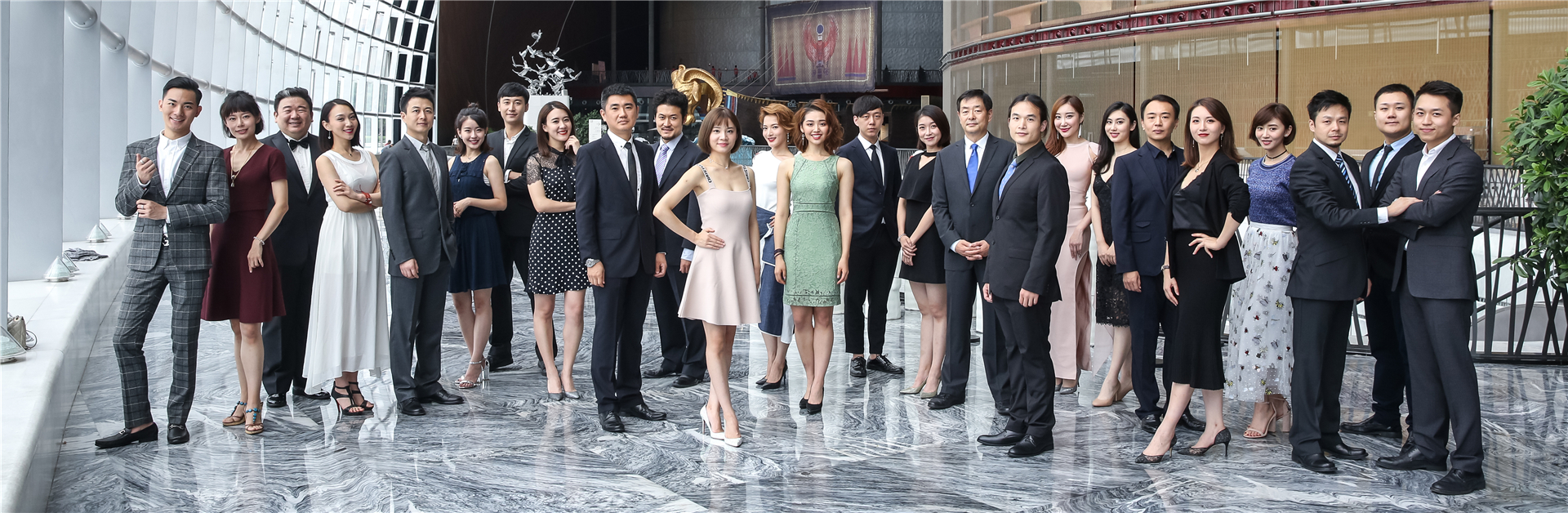 NCPA Drama Ensemble
 Buildings
Exhibitions
Buildings
Exhibitions
 Opening Hours
Services
Opening Hours
Services
 Western Cuisine
NCPA Café
Arts Gifts
Western Cuisine
NCPA Café
Arts Gifts



 This page provides performance information only.

 戏剧场
戏剧场
 小剧场
小剧场
 歌剧院
歌剧院
 音乐厅
音乐厅