-
About
-
Synopsis
-
Conductor
-
Creative
-
Presenter
Guidance
The detailed information will be coming soon. Click our Full Calendar and explore more performance in NCPA.
Music: Pyotr Tchaikovsky
Libretto by Yuri Grigorovich after scenario by Vladimir Begichev and Vasily Geltser
Choreography: Yuri Grigorovich
Including scenes in choreography by Marius Petipa, Lev Ivanov and Alexander Gorsky
Designer: Simon Virsaladze
Music Director: Pavel SOROKIN
Lighting Designer: Mikhail Sokolov
Artistic Director of The Bolshoi Ballet: Makhar Vaziev
About the performance
Swan Lake, the first Tchaikovsky’s ballet, was commissioned by the Bolshoi Theatre. Here, on the 20th of February (old style) 1877 the world premiere in the staging by Julius Wenzel Reisinger took place, and already in 1880, the next approach to stage it was made by Joseph Hansen.
However, the real and uninterrupted stage life of the score, that led Swan Lake into the circle of masterpieces, started in St Petersburg, just after the composer died prematurely. On the 17th of February 1894, as part of a memorial production in the memory of P.I. Tchaikovsky, which was organized by the directorate of the Imperial Theatres, the second act in the choreography by L. Ivanov was performed.
A year later, on the 15th of January 1895, at the Mariinsky Theatre, the premiere was held in a full and renewed version of the ballet. It was headed by Marius Petipa. The production of dances belonged to him and Ivanov (besides the second act, which already existed, the latter created the whole fourth act and two pieces for the palace ball in the third act). The conductor of the St Petersburg ballet, Riccardo Drigo, prepared a new version of the score in accordance with Petipa’s plan. The composer’s brother, dramaturg and librettist Modest Ilyich Tchaikovsky, reworked the anonymous script, written in 1877. Based on circumstantial evidence, he suggested that the original libretto had been written by the manager of the Moscow Imperial Theatres, Vladimir Begichev, and dancer Vasily Geltser.
Traditionally, they are cited as the script writers of Swan Lake. The part of Odette-Odile at the premiere was danced by an Italian ballerina Pierina Legnani and the part of Prince Siegfried by Pavel Gerdt.
In 1901, the ballet returned to the stage of the Bolshoi Theatre. In general, Alexander Gorsky based his production on the version by the Mariinsky Theatre with relatively few changes until that point. For the following twenty years, the ballet master of the Bolshoi Theatre Gorsky would approach Swan Lake three more times, taking it further and further away from the version by Petipa and Ivanov. That version of Swan Lake had a happy ending. Odetta and Siegfried were united and the evil powers were destroyed. In 1922, Gorsky revived the previous version, having included the finds from the 1920 production (the part of the Fool and the dance of masks at the ball).
In 1937, a former student of Gorsky, Asaf Messerer staged anew the fourth act of the ballet. He created the final scene, that has become canonized: Siegfried fought Rothbart and pulled off the evil wizard’s wing. Rothbart died, Odette and her friends were freed from his power. The production by Gorsky-Messerer was performed by Marina Semyonova, Galina Ulanova, Maya Plisetskaya… That version found the final form in 1956, prior to the first tour of the Bolshoi Theatre to London. A new set was created from the sketches by Simon Virsaladze.
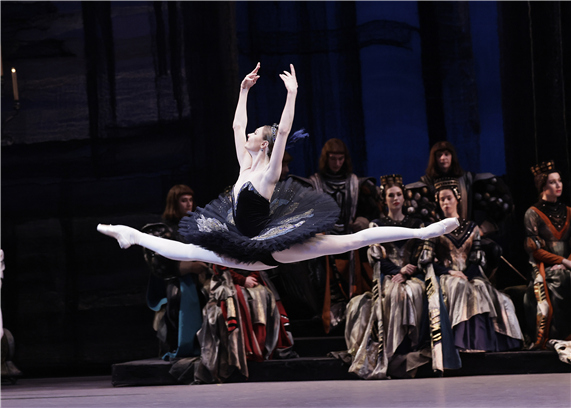
In 1969, before another tour to London, Yuri Grigorovich staged his version of Swan Lake. The foundation for the production was a seriously reconsidered dramatic concept. Grigorovich imagined the events of the ballet as reflections of the internal struggles within the soul of Prince Siegfried. The wizard Rothbart became the Evil Genius, the dark alter ego of the protagonist. The scenes by the lake appeared as a world within his dream. In the finale the White Swan, that was embodied by Odette, was reduced to dust and the prince was left alone, surrounded by emptiness. The composition changed in accordance with the new interpretation. The ballet had two acts and the action shifted from the palace to the lake without any intervals. A significant part of the choreography was recreated.
After the dress rehearsal that took place in the summer of 1969, the premiere was postponed. Grigorovich was required to return to the traditional structure of four scenes, a positive outcome and to abolish the theme of the “double” Siegfried and Rothbart. On the 25
th of December, a "corrected" production was shown to the audience. For the coming decades, the ballet master gradually returned the excluded dramatic novelties (except for the finale). In 1996, a radically renewed version was suggested by Vladimir Vasiliev. Since 2001,
Swan Lake has been performed in Grigorovich’s new version, where the ideas he was unable to realize in 1969, are present, including the tragic ending.
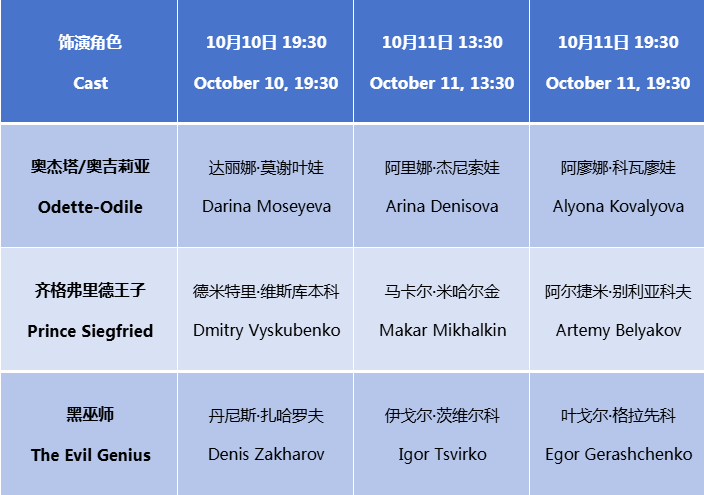
*Please note that cast is subject to change.
Act I
Scene 1
In an old German castle, Prince Siegfried’s birthday is being celebrated; today he comes of age. He is congratulated by his mother — the Princess Mother, friends and courtiers. In a majestic ceremony, Siegfried is made a knight. From this day on, duty and valor will be the guiding principles of his life.
The last toasts are pronounced in his honor and young girls of his age try to attract his attention, but Siegfried is overcome by emotions of a different kind. He dreams of a pure and ideal love. The festivities draw to an end and the guests depart, leaving the Prince alone with his thoughts in the gathering dusk. Night falls. Siegfried becomes aware of a shadow at his side, as if some mysterious force were beckoning to him. It is the Evil Genius — or Fate itself — who has come to reveal some disturbing secrets to the Prince. Submitting to the powerful pull of his invisible companion’s presence and filled with anxious foreboding, Siegfried succumbs to the ideal world of his dreams...
Scene 2
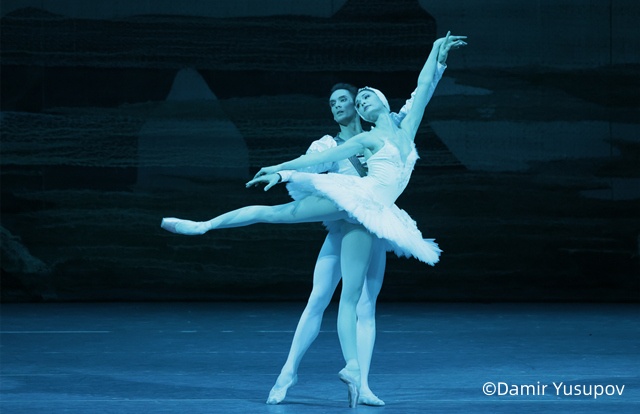
Lured by the Evil Genius, Siegfried finds himself on the banks of a mysterious lake. In the shimmering patches of moonlight on the water, visions of bewitched swan maidens rise up before him. Siegfried catches sight of Odette, the most beautiful of the maidens. He is spellbound, deeply struck by her beauty. At long last, he has found his romantic ideal of love. He swears to Odette that he will love her forever and be faithful to her.
Act II
Scene 3
Prospective brides-to-be are arriving at the Princess Mother’s castle. The Prince must choose one of them to be his wife. But Siegfried can think of nothing but Odette and his meeting with her. He dances in an offhand manner with the noble-born maidens. Not one of them can compare with his ideal.
Suddenly, a mysterious knight arrives at the ball, accompanied by a ravishingly beautiful young girl and a suite of black swans. It is the Evil Genius and Odile, Odette’s double. Struck by their resemblance, Siegfried hurries towards Odile. The Evil Genius is putting the Prince’s sentiments to the test. Siegfried is enchanted by the perfidious Odile, who manages to disarm him of all his doubts. He announces Odile to be his chosen bride.
At this very moment, the throne room is plunged into darkness, and a vision of the beautiful Odette appears before the assembled company. Siegfried realizes that he has become a plaything in the hands of Fate. Hoping to atone for his betrayal, he rushes in despair after the receding image of the white swan.
Scene 4
Night falls. A deep gloom hangs over the lake. Odette brings the tragic news: the Prince has broken his vow of faithfulness to her. Siegfried’s conscience is deeply troubled; he hurries towards Odette, begging for her forgiveness. Odette forgives the youth, but she is no longer mistress of her own fate.
The Evil Genius summons up a storm which disperses and plays havoc with the heroes of our tale, making it impossible for them to unite. Made weak by his single combat with Fate, Siegfried tries in vain to hold on to the vanishing image of Odette. As dawn breaks, he finds himself alone on the empty banks of the lake of his dreams.
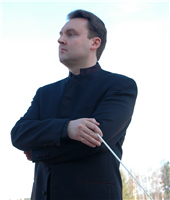
Pavel Sorokin
Pavel Sorokin graduated from the Central Music School in 1980 and entered the Moscow Conservatoire (the piano section, Lev Naumov's class). At the same time, he started to study conducting in Yuri Simonov's class. In 1983, he joined the Bolshoi Theatre as ballet accompanist
In 1987-1989, he studied conducting at the Paris Conservatoire in Jean-Sebastian Berrault's class. In the summer of 1989, he took part in the Tanglewood Festival with the Boston Symphony Orchestra.
At the end of his studies in Paris, having been given an excellent certificate, he joined the Bolshoi Theatre as conductor. At the Bolshoi Theatre as conductor he has mounted the operatic production of Tchaikovsky's Iolanta (1997), ballet productions of Prokofiev's Prodigal Son and Stravinsky's Petrushka (1991), Adolphe Adam's Le Corsaire (1992, 1994), Lovenskjold's La Sylphide (1994), Balda to music by Shostakovich (1999), Tchaikovsky's Swan Lake (2001), Arif Melikov's A Legend of Love (2002 and 2014), Glazunov’s Raymonda (2003), Shostakovich's The Bright Stream (2003) and Bolt (2005), Carmen Suite to music by Bizet and Shchedrin (2005), Asafiev's The Flames of Paris (2008), Dream of Dream to music by Rachmaninov (2012), Stravinsky's Apollon Musagète (2012), Jewels to music by Faure, Stravinsky and Tchaikovsky (2012), Classical Symphony to music by Prokofiev (2012), La Bayadere by Minkus (2013), Onegin to music by Tchaikovsky (2013), Lady of the Camellias to music by Chopin (2014), Don Quixote by Minkus (2016), Anyuta to music by V.Gavrilin (2022) and The Sleeping Beauty (2024)
He was assistant to Mstislav Rostropovich on the 1996 production of Khovanshchina. The conductor's repertoire includes the following, among others, operas Ivan Susanin, The Oprichnik, The Maid of Orleans, Eugene Onegin, The Queen of Spades, Prince Igor, The Tsar’s Bride, Mozart and Salieri, The Golden Cockerel, Khovanshchina, Boris Godunov, Francesca da Rimini, Betrothal in a Monastery, The Gambler, War and Peace, Lady Macbeth of Mtsensk, Il Barbiere di Siviglia, La Traviata, Un Ballo in Maschera, Macbeth, Nabucco, Carmen; ballets Nutcracker, The Sleeping Beauty, Spartacus, The Golden Age, Giselle, Chopiniana, Schnittke's Sketches, as well as symphonic works.
From 2000-2002, Pavel Sorokin was chief conductor of the Radio and Television State Symphony Orchestra.
From 2003-2007, he was chief conductor of the Symphony Orchestra of Russia.
In 2007-2022, guest conductor at the Royal Opera House in Covent Garden. Participated in the Tanglewood Music Festival, held by the Boston Symphony Orchestra (BSO).
His discography includes recordings of the works by Tchaikovsky, Rachmaninov and Grieg with the Academic Symphony Orchestra of the Moscow State Philharmonic, and the Radio and Television State Symphony Orchestra. He is a recipient of the Paradise Award by the Novosibirsk Branch of the Union of Theatre Workers of the Russian Federation (2022) and Saint Petersburg Government Art and Culture Prize (2024).
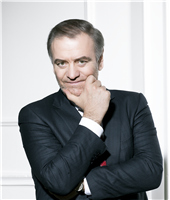
Valery Gergiev
Valery Gergiev is a world famous conductor. While still a student at the Rimsky-Korsakov Leningrad State Conservatory, Gergiev won the Herbert von Karajan Competition in Berlin and the All-Union Conducting Competition in Moscow, following which he was invited to join the Kirov Theatre (now the Mariinsky) as an assistant to the principal conductor. His debut as a conductor at the theatre came on January 12, 1978. In 1988 Valery Gergiev was appointed Music Director of the Mariinsky Theatre, and in 1996 he became its Artistic and General Director. Moreover, since December 2023 he has also been General Director of the Bolshoi Theatre of Russia.
The maestro made his debuts in 1991 at the Bayerishe Staatsoper, in 1993 at the Royal Opera House, Covent Garden and in 1994 at the Metropolitan Opera. He worked with the World Orchestra for Peace, the philharmonic orchestras of Berlin, Paris, Vienna, New York and Los Angeles, the symphony orchestras of Chicago, Cleveland, Boston and San Francisco, the Royal Concertgebouw Orchestra (Amsterdam) and many other ensembles. From 1995 to 2008 Valery Gergiev was Principal Conductor of the Rotterdam Philharmonic Orchestra, and from 2007 to 2015 he was Principal Conductor of the London Symphony Orchestra. From 2015 to 2022 the maestro headed the Munich Philharmonic and from 2018 to 2022 the Verbier Festival Orchestra.
Valery Gergiev’s musical and public activities have brought him many titles and awards of the Russian Federation and prestigious state awards of Armenia, Bulgaria, Germany, Italy, the Netherlands, Poland, France and Japan.
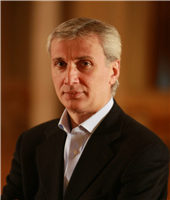
Makhar Vaziev
In 1979, he graduated from the Leningrad Choreographic School (now the Vaganova Ballet Academy) and started to dance with the Kirov Ballet. He was promoted to principal dancer in 1989. His repertoire includes major roles in more than twenty ballets.
In 1995–2008, he was Ballet Artistic Director at the Mariinsky Theatre. During his tenure, the repertoire policy saw a major breakthrough: the playbill started to incorporate works by renowned choreographers of the 20th century, including George Balanchine, Hans van Manen, John Neumeier, Kenneth MacMillan, Harald Lander, Roland Petit, Pierre Lacotte, William Forsythe, and David Dawson. At the same time, ballets by Marius Petipa were revived, based on the notes by Nikolai Sergeyev in accordance with Vladimir Stepanov’s notation, which belong to the Harvard University Library Theatre Collection. As a result, the productions of The Sleeping Beauty, La Bayadère and Le Réveil de Flore staged by Sergei Vikharev provoked a wave of interest in the original choreography of the 19th century around the world. Attention was also paid to the choreographers of the new generation, such as Alexei Ratmansky, Alexei Miroshnichenko, Kirill Simonov, and Noah Gelber. All of them were provided with opportunities to express their ideas on the glorious ballet stage. As a manager, Vaziev actively promoted bright personalities of the ballet company of the Mariinsky Theatre. During his time, a constellation of outstanding performers emerged there: Diana Vishneva, Svetlana Zakharova, Ulyana Lopatkina, Mikhail Lobukhin, Leonid Sarafanov, Evgenia Obraztsova, Alina Somova, Daria Pavlenko, Viktoria Tereshkina, Andrian Fadeyev, Igor Kolb, Vladimir Shklyarov and many more.
Over those years, the Mariinsky Theatre made several successful tours, including performances at the Royal Opera House (London), the Teatro Real in Madrid, Lincoln Center (New York), the Kennedy Center (Washington, D.C.), the Teatro Colón (Buenos Aires), the Bolshoi Theatre, as well as numerous venues in Italy.
In 2008–2016, he headed the ballet company of La Scala in Milan (Italy). During his time there, he enhanced the company’s performance and built up an outstanding repertoire. Among the productions of his tenure were Balanchine’s Jewels to music by Fauré, Stravinsky and Tchaikovsky and A Midsummer Night’s Dream to music by Mendelssohn, Petit’s Pink Floyd, Ratmansky’s Opera to music by Desyatnikov (world premiere), Nacho Duato’s The Nutcracker, Vikharev’s revision of Raymonda, and Ratmansky’s revision of The Sleeping Beauty. The company was reinforced by a talented generation of artists, such as Nicoletta Manni, Claudio Coviello, Massimo Garon, and Marco Agostino.
In March 2016, he was appointed Artistic Director of the Bolshoi Ballet.
In 2002, he was awarded the title of Merited Artist of the Russian Federation, and in 2021, the title of People’s Artist of the Russian Federation. Among his awards are "Spirit of Dance" prize of the Ballet magazine in the "Knight of Dance" category (2002) and State Medal of the Republic of North Ossetia-Alania: "For the Glory of Ossetia" (2019).
The Bolshoi Theatre
The Bolshoi Theatre has always been, and will remain, one of the main symbols of Russia and its culture. It is Russia’s main national theatre, a bearer of the traditions of Russian music culture and a centre of global music culture, the spearhead of the development of the country’s performing arts.The history of the Bolshoi began in 1776. It was the first permanent theatre company in Moscow.
From early on, the Bolshoi offered its audiences productions of operatic ranging from Mozart’s to works by Russian composers. An essential component of every production was the emphasis on acting, which has always been an inherent part of the Bolshoi style, as well as the effective decorative treatment provided by the designers.
With the transfer of the capital from Petrograd to Moscow, the Bolshoi became the country’s leading theatre, a display of the best creative talents. Great singers and dancers were working at the Bolshoi as well as great conductors, choreographers, directors, and set designers.
Today's Bolshoi Theatre employs more than one thousand performers for its opera and ballet companies, choir, orchestra and extras ensemble. Proud of retaining our classical heritage, everyone at the Bolshoi is also aware that growth and development are the only foundation for creative prosperity in the modern world that changes so rapidly. The Bolshoi offers to its audiences both Russian and West European classics from the 19th–20th centuries together with new productions created by the Theatre’s special commissions.
Chamber and symphonic concert programs together with concert performances of operas are an essential part of the Bolshoi playbill, introducing the public to all possible music genres.
The Bolshoi does about 500 performances a season. Both Bolshoi Opera and Bolshoi Ballet perform triumphantly in Russia and on major stages of the world.
Today's Bolshoi is not just a theatre with a 250-years-long history; it is a genuine 21st century theatre.
The Bolshoi Ballet
The internationally renowned Bolshoi Ballet is among the oldest and worldwide acclaimed ballet classical companies. The first ballets to be produced were by French and Italian ballet masters such as Filippo Beccari, the Morelli brothers and Jean Lamiral. Before long, however, young Russian choreographers such as Adam Glushkovsky took over, concentrating on ballets with Russian themes. From 1820-1830 the company developed in the French tradition under the influence of Felicite-Virginie Hullin-Sor and Fanny Elssler who familiarised the Moscow public with works of Jules Perrot and other masterpieces of romantic ballet.
By mid-19th century, Bolshoi Ballet developed its own, so-called Moscow Style, with the emphasis on acting. Marius Petipa's Don Quixote that received its premiere in Moscow on 26 December 1869 became a signature production of the Moscow Company, a work that, infringing all Imperial Theatres traditions, was transferred from Moscow to Petersburg, not the other way around.
Today the chef-d’oeuvres of classical ballet, such as Giselle, La Sylphide, Swan Lake, The Sleeping Beauty, La Bayadère, Don Quixote, Raymonda, Le Corsaire, Coppélia, as well as 20th century’s masterpieces by Yuri Grigorovich, Mikhail Fokine, George Balanchine, Pierre Lacotte, John Neumeier, Alberto Alonso occupy a leading place in the Bolshoi Ballet repertoire.
The Bolshoi has also produced a number of specially commissioned ballets, including works by Yuri Possokhov, Vyacheslav Samodurov, Edward Clug among others.
Nowadays Bolshoi dancers, Svetlana Zakharova, Ekaterina Krysanova, Anna Nikulina, Anastasia Stashkevich, Evgenia Obraztsova, Alyona Kovalyova, Eleonora Sevenard, Elizaveta Kokoreva, Yulia Stepanova, Eva Sergeyenkova, Vladislav Lantratov, Artem Ovcharenko, Semyon Chudin, Vyacheslav Lopatin, Denis Rodkin, Denis Savin, Artemy Belyakov, Igor Tsvirko, Egor Gerashchenko, Dmitri Smilevsky and others ensure that the Bolshoi's standards are held as high as ever.
Makhar Vaziev, former ballet director of the Mariinsky Theatre and the Teatro alla Scala, was appointed Ballet Director of the Bolshoi in 2016.
Beijing Symphony Orchestra
The Beijing Symphony Orchestra was founded in October 1977. In the 1990s, the Beijing Symphony Orchestra underwent a significant reform and reorganization under the leadership of artistic director TAN Lihua. The orchestra has held annual musical events for over ten years, with 90-100 concerts given each year. Starting with the classics, the orchestra has performed nearly 1,000 musical works, including operatic music, symphonic music, chamber music and contemporary music. It has cooperated with world-renowned maestros, instrumentalists and famous international orchestras to expand its repertoire. The Forbidden City Concert Hall, situated in the imperial garden, belongs to the Beijing Symphony Orchestra.
The orchestra has worked with many famous orchestras and top musicians, such as the Berliner Philharmoniker, London Philharmonic Orchestra, Russian National Orchestra and Royal Philharmonic Orchestra; famous virtuosos include maestro Gennady Rozhdestvensky, Yevgeny Svetlanov, Christoph Eschenbach, Lawrence Foster, Thomas Sandrine, Andrew Davis, Leif Segerstam and Pavel Kogan; piano virtuosos include Lazar Berman, JustusFrantz , Jean-Yves Thibaudet and Tzimon Barto; violin virtuosos Vadim Repin, Midori Gotō, Lin Cho-Liang, Christophe Barratier and Sergey Krylov; cello virtuosos include Mischa Maisky, Lloyd Webber and Corona Crainey; viola virtuoso Yuri Bashmet; trumpeter Garber Portotzky; singers José Carreras and Jennifer Larmore.
Maestro Eschenbach said, “The Beijing Symphony Orchestra is an orchestra with high professional qualities. Their extremely strong musical apprehensiveness and performance style have impressed me deeply." Over the past decades, Beijing Symphony Orchestra made many achievements, one of which is its first international commercial tour in 2001. By far, the orchestra has given commercial performances worldwide for years.
The Beijing Symphony Orchestra shows special preference to contemporary Chinese music compositions. It has planned, participated in, commissioned and premiered new works by most of the contemporary Chinese composers, and it has premiered nearly 200 works. Since 2007, the orchestra has released eight record albums globally with EMI Records, a world-famous music label founded over a century ago.
The Beijing Symphony Orchestra has taken part in many large-scale international cultural exchange activities, and made several visits to Germany, the UK, Switzerland, Austria, Italy, Czech, Poland, Croatia, Hungary, Turkey, Slovenia, Serbia, South Korea, the USA, Canada and Montenegro. In 2001-2017, the orchestra toured Europe for eight times and won high praise from the European critics. In 2013, the orchestra made its debut in America during a two-week tour to Mexico and the USA. The Washington Post gave it a banner headline: “The Beijing Symphony Orchestra starts an Upsurge of Classical.” In February 2017, the orchestra gave a classic symphony concert at the Kennedy Center, receiving high acclaim from the audiences. It gave virtuoso performances at the Sony Centre for the Performing Arts in Toronto and National Arts Centre in Ottawa, Canada, kicking off celebrations for the 150th anniversary of the founding of Canada. The joint performance given by the Beijing Symphony Orchestra, Ottawa Symphony Orchestra and Canada’s National Arts Centre Orchestra was the first one to be given by the three orchestras together after the founding of Canada, which is of great historical significance. In September the same year, Beijing held the second 16+1 Summit of China and CEE Capitals Mayors in Podgorica, Montenegro as well as the “Beijing Day” Event in Belgrade, Serbia. Deputy Party Secretary and Acting Mayor of Beijing CHEN Jining attended the activities with a government delegation. The Beijing Symphony Orchestra gave a symphony concert under the theme, “Tour of Friendship” at the Podgorica National Theatre and Belgrade Sava Central Theatre respectively. The orchestra signed a memorandum of understanding with the Montenegro Symphony Orchestra and Serbia Belgrade Symphony Orchestra, entering into a specified relationship with them. Also, a symphony orchestra league was formed by Beijing with its international sister cities, enriching the connotations of the second 16+1 Summit of China and CEE Capitals Mayors and “Beijing Day” Event in Belgrade, Serbia, and achieving substantial results in cooperation.
In 1994, the Beijing Symphony Orchestra started devoting itself to popularizing symphonic music on a large scale in military camps, factories and mines, schools and communities in Beijing as well as Chinese concert halls and institutions of higher education. Over the past 20 years, the orchestra has held nearly 1,000 concerts for symphony popularization for millions of spectators of different professions and ages in school canteens and halls, factories and communities, as well as at opera houses and concert halls in Beijing, Shanghai and other major cities. In the 2014 season, it gave the opening concert on campus. In 2016, it initiated an activity titled, “Capital Civic Hall” and performed “symphonic music for common people”, introducing classical music into capital citizens’ daily life.
As the 2019 season is now on, all members of the Beijing Symphony Orchestra are writing a more brilliant artistic chapter with full passion in high spirits.
*Please purchase tickets through authorized channels to avoid counterfeiting. Before completing your purchase, please verify the performance date, time, venue, and seat number carefully. Performance tickets are time-sensitive and limited in availability. Once a transaction has been completed, tickets are non-exchangeable, non-refundable and cannot be reissued if lost. Please double-check all ticketing details and securely retain your physical ticket or electronic order. If you are unable to attend due to personal reasons, please make your own arrangements regarding the use of your tickets. We appreciate your understanding as any inconvenience caused.
*The cast, programme, or other performance details are subject to change and shall be based on the live performance. In the event of major adjustments - such as changes to the performance date or lead cast - please refer to the official announcements issued by the NCPA and follow the relevant procedures as instructed.
*The NCPA opens 90 minutes before performances, and 60 minutes before art education lectures and similar events. Auditorium entry begins 45 minutes before performances. For all performances and events, the Northern entrance serves as the sole public entrance. Please ensure that ticket scanning and security screening are completed prior to entry, and allow sufficient time to avoid delays.
*Tickets must be retained in their original, intact condition. Admission will be denied for tickets lacking a stub, or bearing any alterations, obscured information, or defacement. Each ticket is valid for a single entry on the date of the performance. For certain performances, presentation of original valid identification documents is required. Admission will be granted only when the ticket information corresponds with the presented identification.
*Recommended admission height: 1.2 meters and above. Special provisions may apply to certain performances or events, as indicated on the corresponding ticketing page.
*All attendees are required to undergo security screening upon entry. Smoking and open flames are strictly prohibited within the NCPA premises. Prohibited items include, but not limited to, firearms and replicas, controlled knives, flammable or explosive substances, toxic or hazardous materials, corrosive substances, and radioactive materials. Any prohibited items discovered will be handed over to public security authorities.
*For safety and hygiene reasons, the NCPA does not provide storage services for food, beverages, or similar items. The following items are not permitted inside the NCPA: food and drinks, flags & banners, electronic cigarettes, power banks exceeding 20000mAh, flowers, recording or photography equipment, and oversized luggage.
*Attendees are requested to address appropriately. Admissions will be denied to individuals who are improperly attired or under the influence of alcohol.
*If you are late, please wait quietly in the audience waiting area. Entry will be permitted under the guidance of ushers during appropriate intermissions or between movements, and you are requested to take the nearest available seat with minimal disturbance. For concerts consisting of a single piece - either for the entire performance or a complete half - late arrivals and audience who leave midway will not be admitted.
*All attendees are requested to observe proper performance etiquette. Please keep quiet and remain seated throughout the entire performance. Mobile phones should be turned off or set to silent mode, and calls should not be made in the auditorium. Photography, audio, or video recording of the performance is strictly prohibited without prior permission. The use of flashlights, including phone flashlights, is not allowed.
*After the performance, please exit the auditoriums in an orderly manner. Loitering is discouraged.



 Repertoire
 Films
Films
 Videos
 Podcast
 China NCPA Orchestra
 China NCPA Chorus
 NCPA Resident Singers
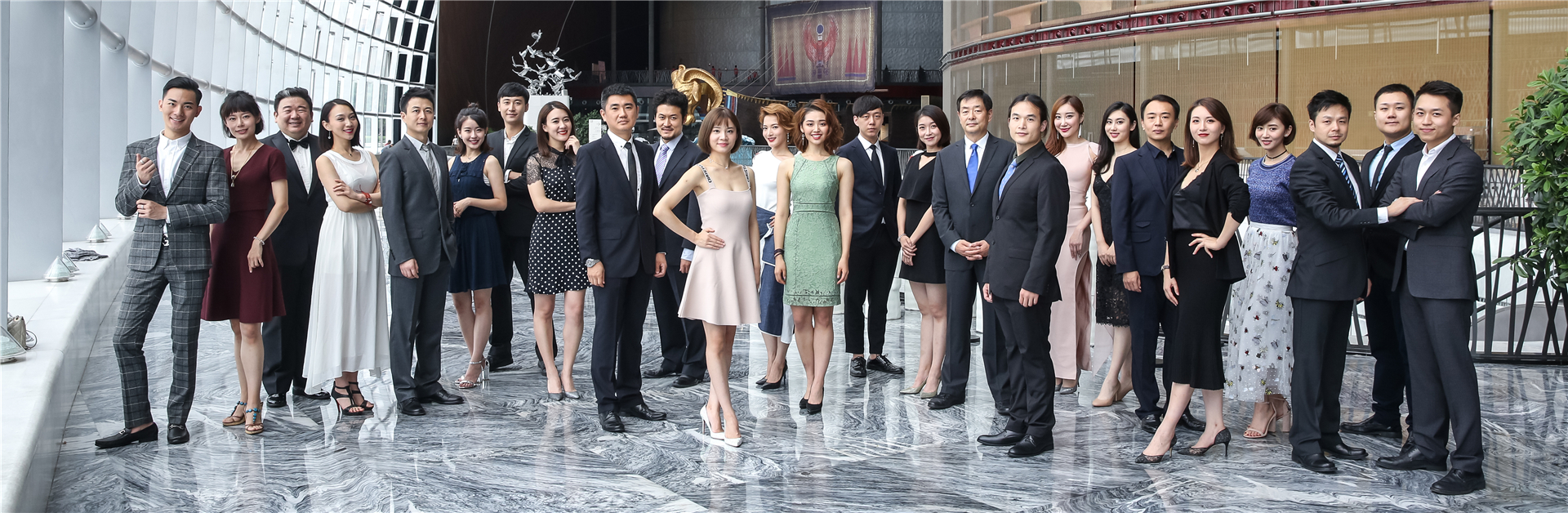 NCPA Drama Ensemble
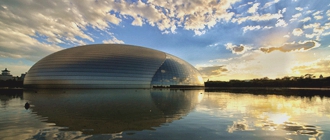 Buildings
Exhibitions
Buildings
Exhibitions
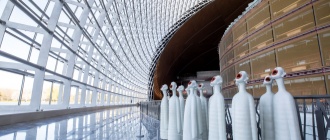 Opening Hours
Services
Opening Hours
Services
 Western Cuisine
NCPA Café
Arts Gifts
Western Cuisine
NCPA Café
Arts Gifts



 This page provides performance information only.

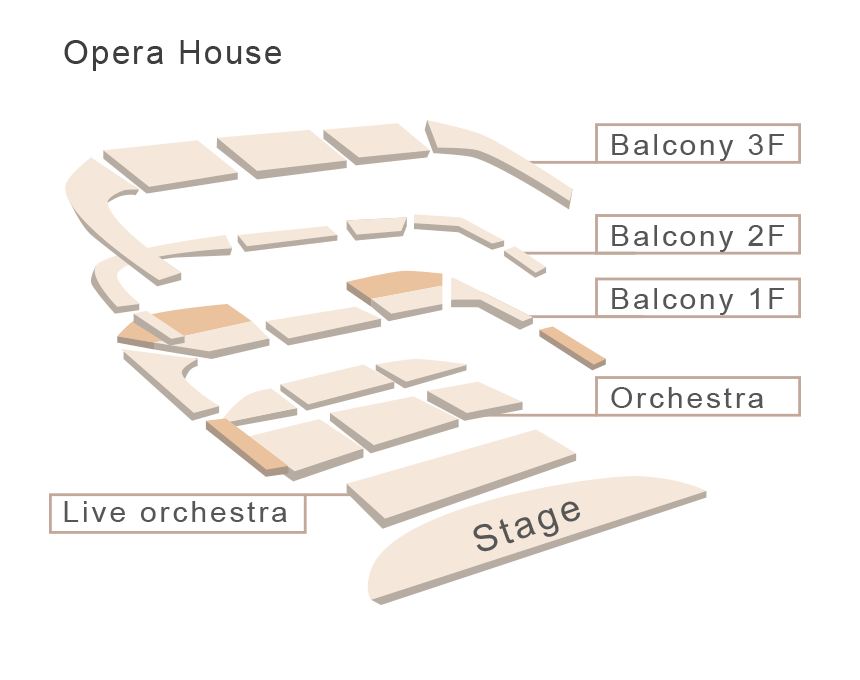 歌剧院
歌剧院
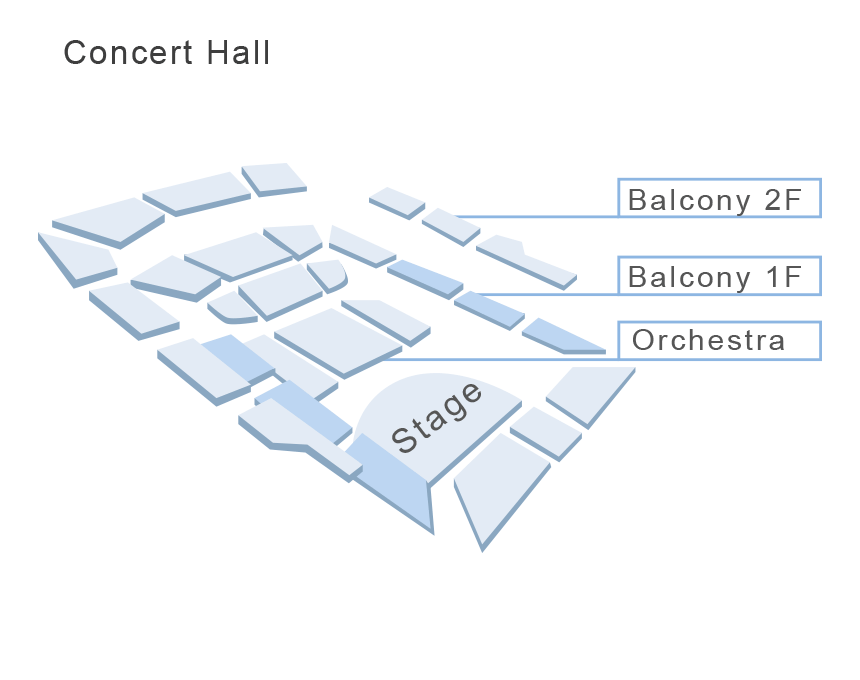 音乐厅
音乐厅
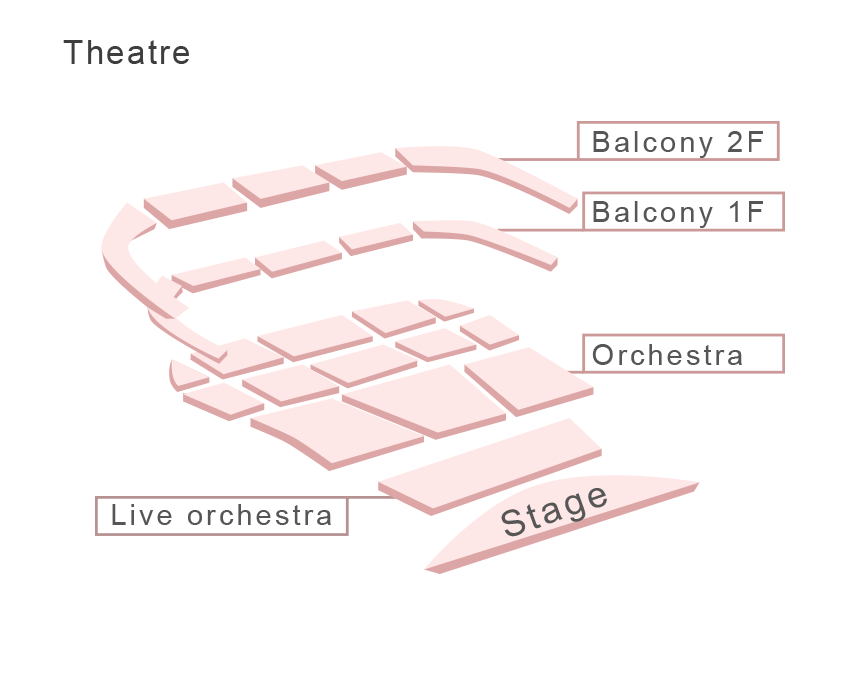 戏剧场
戏剧场
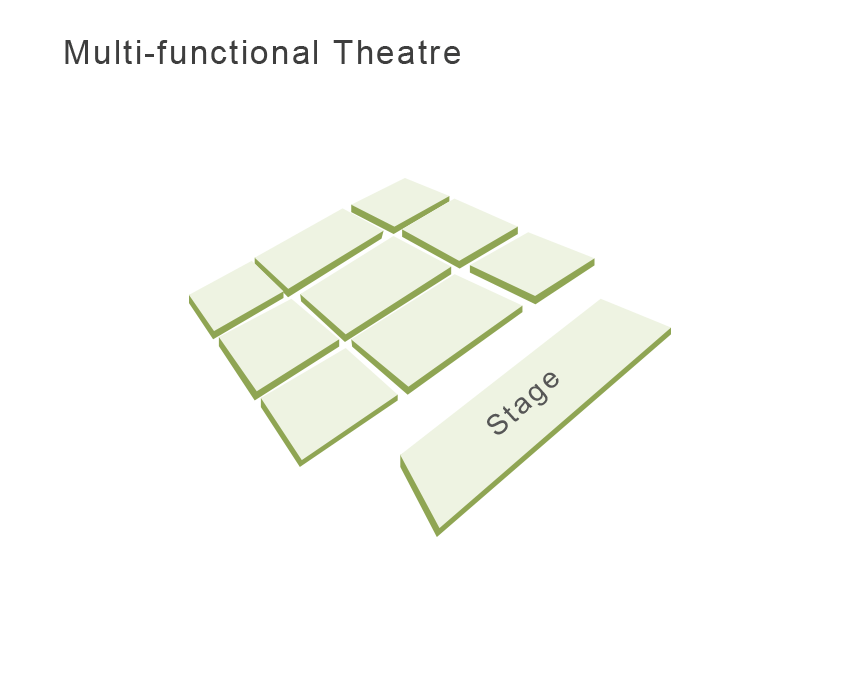 小剧场
小剧场