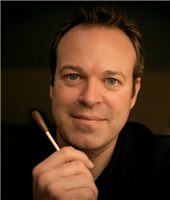
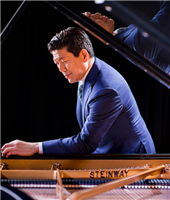
Meng-Chieh Liu first made headlines in 1993 as a 21-year-old student at the Curtis Institute of Music, when he substituted for André Watts at the Academy of Music in Philadelphia with three hours’ notice. The concert earned high acclaim from critics and audience alike and was followed by a succession of major engagements, including a recital at the Kennedy Center, a concert on the Philadelphia All-Star Series, and a performance with the Philadelphia Orchestra. By then, already an accomplished artist, Liu had appeared at Carnegie Hall in 1987 and had been invited to perform with the New York Youth Symphony in 1991.
Born in Kaohsiung, Meng-Chieh Liu studied at the Kaohsiung Municipal Yancheng Elementary School and in the junior music class at the Affiliated Senior High School of Taiwan Normal University, where he was taught by LI Jinli and SONG Yunpeng. He also studied the violin and conducting with CHEN Qiusheng. He began winning competitions in primary school. At 13 he took the first prize in the piano junior category at a regional music competition in Taiwan. At 14 he won the first prize at the Asia-Pacific Youth Piano Competition, which brought him immediate attention. He then entered the Curtis Institute of Music, studying with Jorge Bolet, Claude Frank, Gary Graffman, and Eleanor Sokoloff. At 16 he won the the First Prize in the Mieczyslaw Munz Competition and the Stravinsky International Competition.
His performing career was taking off when a sudden, rare illness cut it short. An overactive immune system attacked his muscles, skin, joints, and heart. During more than a year in hospital, he was paralysed and unable to move. At one point, his doctors gave him almost no chance of survival, and even if he could survive, they believed he would never play the piano again. Yet by sheer determination and rigorous physical therapy, he passed numerous tests, recovering miraculously and returning to the stage. The ordeal did not break him. Instead, it deepened his understanding of music and lifted his artistry to a higher level. After his recovery, he came back as a soloist, giving piano recitals and collaborating with conductors and orchestras including Christoph Eschenbach, Gustavo Dudamel, Alan Gilbert, and other maestros.
In 2002, Meng-Chieh Liu received the Avery Fisher Career Grant and the Career Advancement Award by the Musical Fund Society of Philadelphia, further confirming his commitment to music and professionalism. His performing career has been active across major American cities and in the UK, France, Spain, Bulgaria, Venezuela, New Zealand, Australia, China. Keen on chamber music as well, he has collaborated with many musicians from North America, Europe, Australia and Asia, including Chinese musicians such as YU Long, ZHANG Guoyong, HUANG Yi, NING Feng, LI Xincao, LIN Daye, SHUI Lan, and LIN Zhaoliang.
Meng-Chieh Liu is a frequent guest at music festivals around the world, performing with musicians and chamber ensembles such as violinists Ashkenazy, James Buswell and Wendy Warner, cellists David Soyer and Bernard Greenhouse, the Borromeo String Quartet and the St. Lawrence String Quartet. In 2009, he joined the Chicago Chamber Musicians, and served as its music director from 2011 to 2014. Over more than two decades with this chamber orchestra, he shared the stage with many experienced chamber musicians, including senior members of the Chicago Symphony Orchestra, at more than thirty concerts each year. Beyond music, he has worked with the super dancer Mikhail Baryshnikov and the White Oak Dance Programme, taking part in crossover performances. His live concerts are often broadcast on radio, and television in Taiwan has aired a feature on his life.
In recent years, Meng-Chieh Liu has set new goals in his performing career, hoping to leave a record and some thoughts behind for students and audiences. He has performed the complete Schubert piano sonatas and the complete Brahms piano solos. In January 2014, he recorded Beethoven’s Piano Concerto No. 4 and Piano Concerto No. 5 with the Taipei Symphony Orchestra, released in Taiwan. In 2021, he returned to Taiwan to perform alongside the Taiwan Philharmonic, and gave a recital, “Years of Pilgrimage”, at the Kaohsiung Center. In 2022, his album of the complete Chopin nocturnes was released by Decca, and it won the Best Performance Award at Taiwan’s Golden Melody Awards for Traditional Arts and Music in 2023.
His gift for music and his love of it carry from the concert hall into the classroom. In 1993, when he was just 21 years old, Meng-Chieh Liu graduated from the Curtis Institute of Music and joined the faculty. He became the youngest professor in the institute’s history and the first Asian piano professor since its founding. In his teaching he respects the original work while stimulating his students’ imagination and bringing them new musical energy. In terms of technique, he attends to how the body and the fingertip work together, and to how weight is carried into the key. He places even greater stress on the relationship between the fingertip and the key. In his teaching, he also values his students’ ability to collaborate. Besides helping them build up their solo repertoire, he encourages them to work with other instrumentalists and vocalists in chamber music of many genres. When teaching at Curtis, he led by example, continually expanding into modern repertoire and guiding his students into the study of new works. When working as Head of the Piano Teaching and Research Department, he created a course in modern piano music and invited leading contemporary composers to speak in person, giving his students a chance to hear from the composers first-hand. In recent years, his students have done well in major international competitions, including AN Tianxu, who won the Fourth Place in the 2020 International Tchaikovsky Competition, and Aimi Kobayashi, who won the Fourth Place in the 2021 International Chopin Piano Competition.
Meng-Chieh Liu is widely respected and valued for his teaching. He taught at the Curtis Institute of Music for thirty years, and from 2006 to 2014, he was a guest professor of piano at the Roosevelt University in Chicago. In the autumn of 2014, he joined the New England Conservatory. He also spent six summers at the Tanglewood Music Center, from 2014 to 2019, teaching and mentoring.



 Repertoire
 Films
 Videos
 Podcast
 China NCPA Orchestra
 China NCPA Chorus
 NCPA Resident Singers
 NCPA Drama Ensemble
 Buildings
Exhibitions
 Opening Hours
Services
 Western Cuisine
NCPA Café
Arts Gifts



 This page provides performance information only.


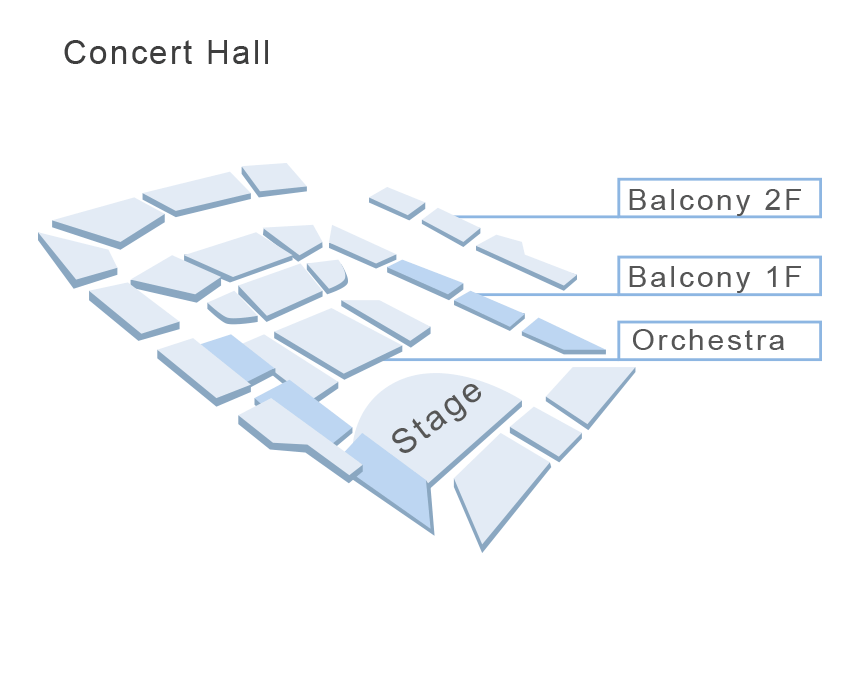 音乐厅
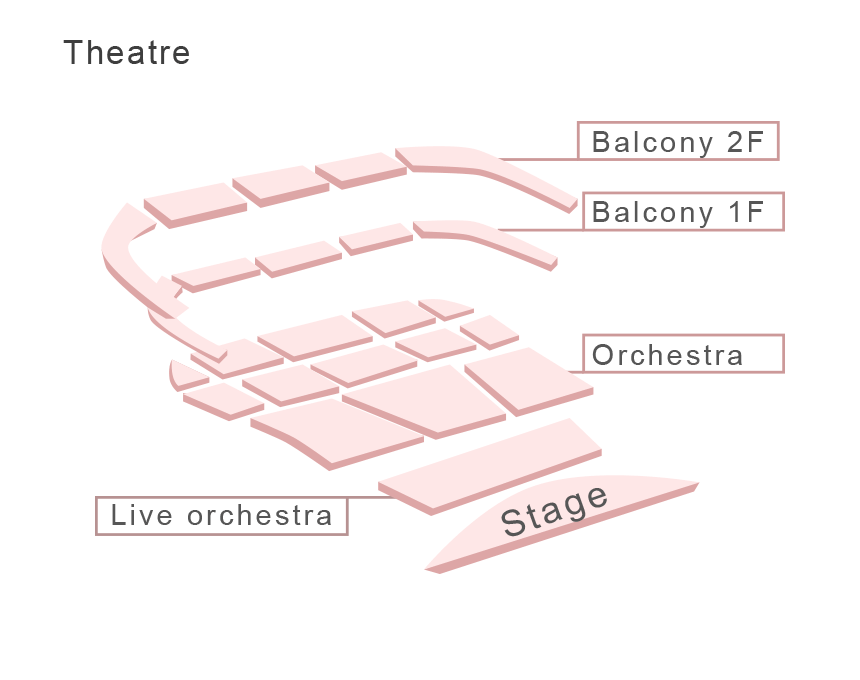 戏剧场
 小剧场
 歌剧院